# Where Do Apps Go in the Digital Era?
For an ordinary person, how many Apps do they use on their phone every day? Relatively high-frequency scenarios such as social e-commerce, daily necessities, banking services, and video entertainment are increasingly converging into the "Super Apps" provided by large internet platforms. Independent third-party Apps, even when focused on specific groups in niche sectors, still have to fiercely compete with a large number of other competitors for that tiny screen in consumers' hands.
Our phones are filled with Apps screen after screen, and the vast majority are zombie Apps. As consumers, the ones we use daily are all Super Apps, and the number doesn't exceed ten fingers. The rest are all illusions, right?
B2B Apps Are All Lifeless Information Silos
As working people, who doesn't have a few Apps on their phone that are designated for use by employers or clients – mobile office, enterprise collaboration, business connections with industry partners, dedicated business development tools for serving customers, and so on. Most of these Apps are quite unpleasant to use. For example, the experience is poor yet optimization and upgrades never come; desired features take forever to go live; they are complete information silos that cannot connect with other commonly used tools; you can't see other colleagues' activities or interact with them, and so on. This leads us working people to develop certain misunderstandings and complaints about our fellow working IT comrades, right?
The Fixed Mindset of Informatization
For IT in traditional industries lacking internet DNA, most still view App development through the fixed mindset of the "informatization" era: both C-end and B-end Apps are mobile applications with no technical difference, and an App is merely presenting application logic on a smaller screen with a friendlier interactive experience – you can't expect users to open a browser and type in a URL on a few-inch phone screen, right? The Apps on the screen are essentially just shortcut links...
Under this fixed mindset, no matter what programming language is used to develop an App, there is no difference from developing a website with HTML + CGI 30 years ago. That is: our company already has these systems, and now we need to wrap a layer around them and output them to the internet for our customers and partners to use. This is the so-called informatization, which, on the basis of "computerization" (replacing manual labor with local software systems), connects to the network so that data bytes can be submitted in and transmitted out, forming "information."
Is that how Apps are supposed to work?
Digitalization Doesn't Work That Way
Apps are products of the digital era. Can we continue to apply the thinking of the informatization era? This comes back to a fundamental question: what is digitalization? Is digitalization just informatization in a trendy new outfit?

In plain terms, the origin of digitalization was brought about by the emergence of smartphones and the mobile internet. It is when consumers hold in their palms a device whose performance equals or even surpasses most personal computers, and when the use of this device is unconstrained by time and physical space, that consumers have "turned the tables." They can make payments and shop, book tickets and travel, invest and manage finances, and enjoy entertainment at any time and any geographic location. Enterprises providing services to C-end customers have no choice but to respond to consumers at all times, and to win consumers' favor by optimizing their own service experience in order to stand out from homogeneous similar services. So "digitalization" = "customer-centric" – this time it's not just a slogan. In other words, "computing power" has achieved tremendous growth in the hands of ordinary people, and consumers have gained the power of discourse.
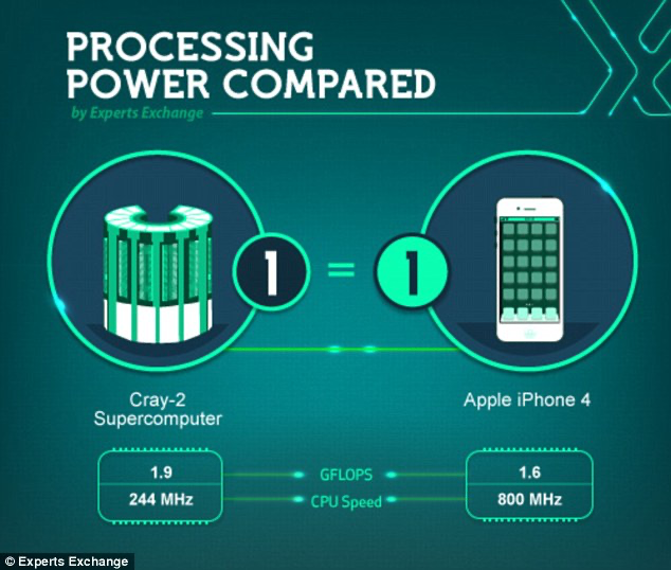
Let's compare the Cray-2, possibly the world's fastest supercomputer in 1985, with the 2018 iPhone XS, and see how in these thirty years, the "computing power" in the hands of ordinary people (so ordinary that they're uncles and aunties who have never used a personal computer in their lives) has gone from "utterly impoverished" to what terrifying number:
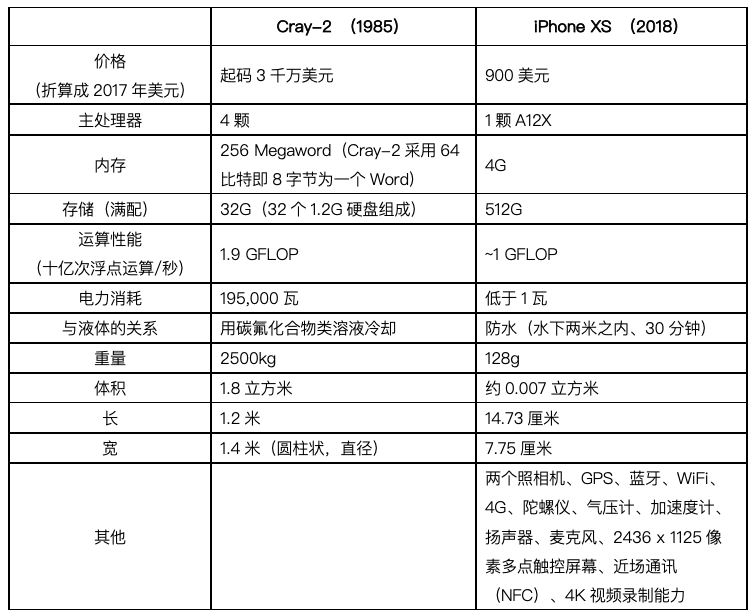
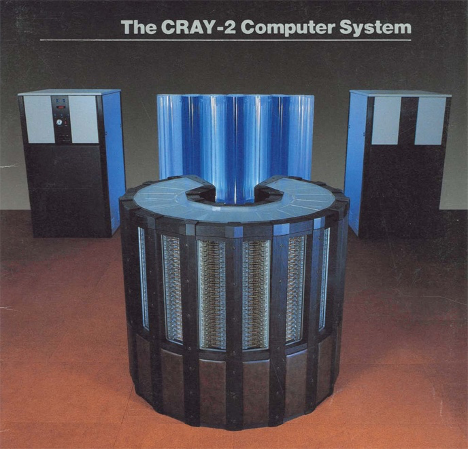
(Less than an iPhone)
If this comparison isn't intuitive enough, let's look at the Apollo Guidance Computer on the Apollo 11 lunar rocket that landed on the moon in 1969 – 32,768 bits (that is... 4K!) of memory, 589,824 bits (72K) of read-only storage, and a 0.043 MHz processor. Fifty years later, in 2019, an iPhone in the pocket of any ordinary person has 34,359,738,368 bits (4GB) of memory, 4,398,046,511,104 bits (512G) of storage, and a processor frequency of 2490 MHz – respectively over 1 million times, 7 million times, and 100,000 times that of the Apollo 11 lunar rocket's guidance computer (Note: not a direct frequency multiple; converted to computing speed).
That is to say, each of us now carries in our pocket a computer equivalent to the world's top supercomputing capability 35 years ago, and it is a million times more powerful than the computer that successfully landed a rocket on the moon 50 years ago!
But a phone is not just a shrunken, portable computer. If you think size is an insignificant, non-essential "form factor," you are greatly mistaken. Size matters! Size is another important reason, besides computing power, that opened the digital era. It is precisely size that allows consumers to break through the constraints of time and space – whether on the sofa, at the dining table, on the train, at tourist attractions... "With one device in hand, the world is mine."
Furthermore, let's not forget that a phone first and foremost exists as a communication device. Its primary attribute is that of a "Communicator" – a social tool connecting people to people.
The smartphone, with its three fundamental attributes of powerful computing, portable size, and communication capability, as an invention and innovation of a production tool, has led humanity into digital civilization...
Can software developed on such technology simply copy the practices of PC software/websites from the informatization era?
How Should C-End Apps Work?
On the consumer side, it's entirely the realm of internet platforms. They are the traffic gateways, the Super Apps, the things consumers use at high frequency in their daily lives. For enterprises in most vertical industries, the ability to develop Apps is limited, the skills to operate App traffic and daily active users are insufficient, and the internet-oriented DNA is lacking. To do their own Apps well and stand out in the app market is truly difficult. The input-output ratio of R&D is also poor.
But as the Western saying goes: "If you can't beat them, join them." So the more practical strategy can only be as follows:
- First, embrace the internet traffic platforms where consumers are, adopt the technical frameworks opened by those platforms, and "move" your products and services onto those platforms so that the platforms' users can discover and use them. Any internet product worthy of being called a "platform" must have technical standards, technical interfaces, an open ecosystem, and welcome third parties to "move in." The typical example is the well-known "Mini-Program";
- Second, we can still provide Apps to consumers. The target audience is the existing users who have been "channeled" through the aforementioned platforms and retained. They may, as customers, need a more direct, more authoritative, and more powerful connection tool to reach the enterprise.
So our strategy is to transform ourselves into an "octopus," extending our products and services like tentacles to third-party traffic platforms. For example, when users use our Mini-Program on a third-party platform, they can be prompted to download a more powerful and more direct App.
Don't forget that the App we provide to consumers needs to fully leverage the phone's social communication attributes, allowing consumers to reach our customer service, account managers, and experts through the App. If users are in the App but cannot contact your employees, can't vent their complaints, can't make suggestions – all on a communication device – isn't that a foolish thing? Your employees should also be on the same App, or another connected so-called B-end App.
How Should B-End Apps Work?
These Apps are typically aimed at aggregating highly specialized and professional tools or tool sets for our enterprise employees and partner personnel. For example, banks, insurance companies, and real estate companies can provide mobile business development tools to their branch account managers, insurance agents, and brokerage intermediaries, aggregating various applications such as CRM, ERP, administrative management, and collaborative office work – euphemistically called "empowerment."
Whether such Apps can succeed depends not only on the company's "administrative orders" forcing employees to use them, but ultimately on whether they are "useful." But how can they be useful? That's not something product managers can achieve by brainstorming – it's something users hammer out by throwing bricks. How can an App avoid being hammered to death and survive to the day of success? There is only one trick: agile iteration, frequent upgrades, rapid updates, and responding to brick-throwing.
When users complain about a feature, improve it immediately – results in a few days; when users find something interesting and start making suggestions, implement them quickly – done in a week; when business departments see hope and gradually increase their demands for business innovation ideas, quickly let them see a prototype for trial... Users' confidence rises, a virtuous cycle is established, and this "empowerment" App has some hope of success.
LEGO-fied Apps
The solution is to break the App into pieces, modularizing functionality to the greatest extent possible, with loose coupling and mutual non-interference. Modifying one functional module does not affect other modules; adding or removing functional modules does not affect the entire App. The ideal way to build an App is to assemble it like building blocks. "Wait," the technical developer responsible for App R&D will say, "we've been modularized for a long time – no one understands modularization better than me."

What's the actual result? Isn't the App getting heavier and heavier, iteration cycles getting longer and longer, and the regression testing burden growing with more features?
What we call "LEGO-fication" must achieve the following:
- Each "LEGO brick" has an independent lifecycle – independent of the App's own lifecycle, independently testable, independently releasable, independently monitorable, and independently removable;
- The developers of each "LEGO brick" can be different people and teams, and can even have nothing to do with the App assembler – just as the App developers in the iPhone's App Store can have absolutely nothing to do with Apple's technical team;
- The quality and stability of each "LEGO brick" itself does not affect the performance and security of the App in which it runs.
In a word, functional modules and the App achieve extreme loose coupling.
Are there examples of this? The well-known Mini-Programs, the Quick Apps that phone manufacturers have tried to promote, and the Clip technology that Apple has supported since iOS 14 – all are examples. Take the WeChat App as an example: between it and the millions of Mini-Programs on the internet that it supports running, there is extreme loose coupling. Each Mini-Program is developed and maintained by a different team, independently listed and delisted, independently upgraded, independently tested, and independently run, without interfering with each other.
FinClip – A Development and Runtime Platform for Super Apps
The good news is that now any enterprise can easily and simply acquire the technical capabilities that only the big tech companies previously possessed. The solution is FinClip, a 100% privately deployable, cloud-native Mini-Program open ecosystem platform that integrates DevOps capabilities. It instantly gives any enterprise the ability to build "LEGO-fied" Super Apps and transform into a Mini-Program platform operator. Enterprise IT can develop Mini-Programs on their own, or open the platform for third-party partners to provide Mini-Programs. Through listing and delisting management, a rich Mini-Program ecosystem can be listed in their own App. The needs of any business department can be responded to quickly in parallel, and the trial-and-error cost of any innovative feature can be controlled to the greatest extent possible. Agile iteration and continuous delivery are no longer just slogans.
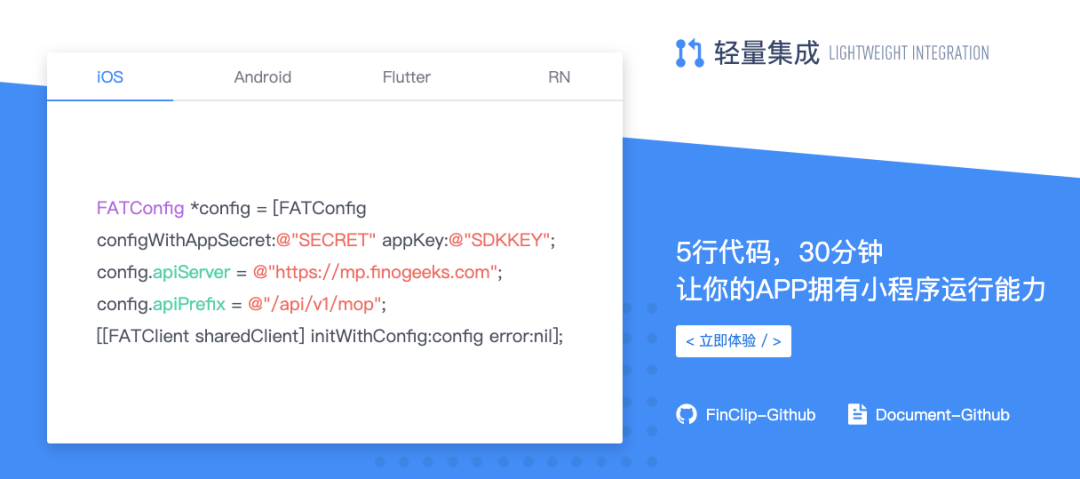
Apps developed based on FinClip have the following powerful advantages:
First, enterprises that adopt this platform naturally possess a veritable technology middle platform: 100% fully containerized, fully leveraging container orchestration technology to achieve tens-of-millions-level concurrency support, and efficiently managing and controlling front-end "fragments" (Mini-Programs) and back-end "fragments" (microservices). The back-end "listing/delisting" management capability gives enterprises an internal "App Store" mechanism for the first time. The introduction of the "listing" concept makes the digitalization granularity of application scenarios inside and outside the enterprise fully controllable. Any feature can undergo AB testing and gray release; any campaign-type or operational scenario can be quickly implemented, with code discarded after use. Apps built this way possess powerful, middle-platform-led, cloud-side operational capabilities.
Second, Apps built on FinClip are no longer information silos. This is reflected in three aspects:
- Any business scenario within the App can be shared to mainstream third-party internet social platforms, thereby generating dissemination, traffic channeling, and customer acquisition effects;
- Support for in-app search, allowing users to conveniently index any content and data running within the App;
- Support for internet web crawlers and search engines to index content within the App (with controllable scope and granularity), similar to SEO practices for one's own website, equally applicable to Apps. In other words, if we want the transparency of content in our App to be the same as an ordinary website so that internet users can search for it, it can be fully achieved.
Because any granularity of digital scenarios can be freely implemented on FinClip, using algorithms to assemble various "LEGO bricks" based on users' personalized characteristics to achieve personalized experiences and intelligent recommendations is no longer an empty phrase. Any Mini-Program on FinClip can dynamically control its visibility scope based on user profiles and customer segmentation. For example, an operational campaign Mini-Program visible only to gold members in a certain region can be published through simple configuration without writing any complex application logic code.
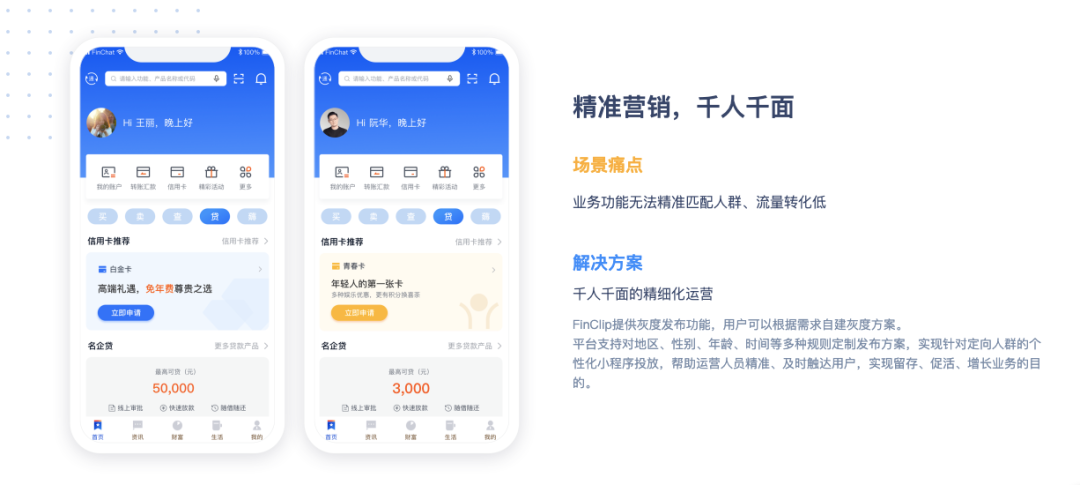
A Digital Ecosystem Operations Platform
Secondary development on the FinClip platform is entirely built on mainstream internet technical standards or de facto standards. Its design logic is to strive for developers to rapidly achieve productivity without specially learning and mastering closed, niche technical skills. Enterprises using FinClip focus on business operations rather than App R&D, because they can easily find a large number of developers in the market, including but not limited to third-party developers, outsourced engineers, freelance technical professionals, and interns – as long as they have basic knowledge of Mini-Program development on the internet, they can develop a large number of one-time, occasional operational campaign scenarios with an extremely low technical threshold, such as mini-games, simple temporary event registration forms for target customers to fill out, questionnaire surveys, and so on.
Enterprises with a business ecosystem can open their FinClip platform to let partners develop Mini-Programs and list them in their own App, forming rich and colorful scenarios and features to serve customers. For example, a bank credit card App can list a large number of third-party consumption scenario Mini-Programs, and a travel App can list Mini-Programs from food, accommodation, and transportation partners, ultimately achieving a customer-centric digital service closed loop.
FinClip brings entirely new possibilities to any enterprise App.