# Another Honor Added! FinClip Wins the "Bank Digital Technology Innovation Award"
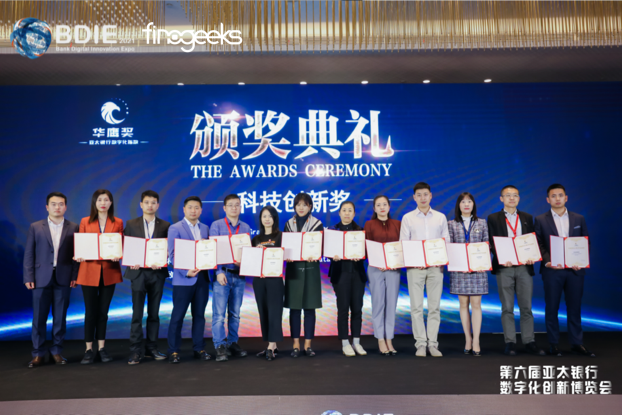
On April 22, the "2021 6th Asia-Pacific Bank Digital Innovation Expo" was held in Shanghai. With the theme of "Accelerating Digitalization, Leading Banking Business Innovation," this year's forum attracted industry elites from commercial banks such as Bank of China, China Merchants Bank, and Agricultural Bank of China, as well as fintech companies. The event aimed to gather pioneering industry representatives to jointly promote the healthy development of bank digitalization, facilitate the scientific, efficient, and sustainable transformation and development of major commercial banks, and comprehensively accelerate the process of building digital banks and constructing an open smart banking ecosystem.
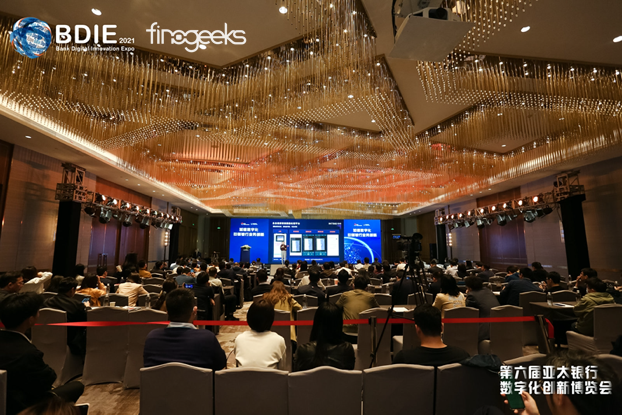
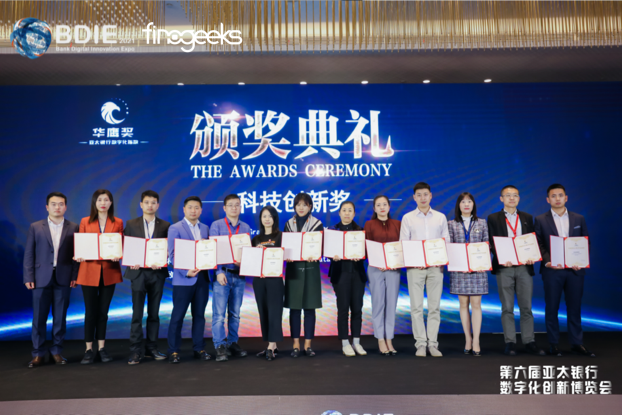
During the forum, FinClip, with its unique Mini-Program Framework technology and continuous innovation and exploration capabilities in the financial sector, won the Technology Innovation Award presented by the Asia-Pacific Banking Federation
**
Yang Tao, Co-founder of FinClip, accepted the award on behalf of FinClip and delivered a keynote speech titled "How to Use Mini-Programs to Explore Open Banking Construction."
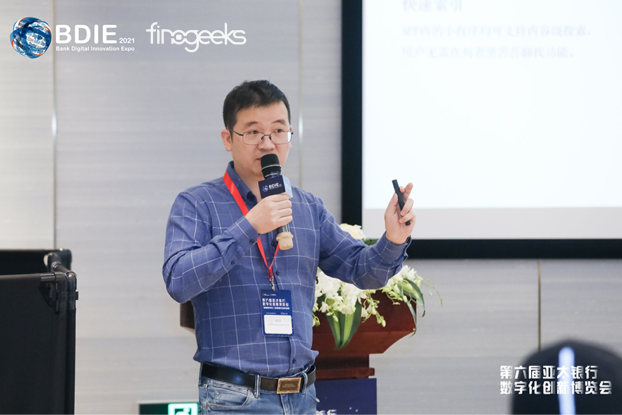
Yang Tao stated: The mobile internet has completely changed the habits of financial consumption, and the trend of financial services migrating online and to mobile is evident. Apps have become the strategic carrier platform for banking business, and need to evolve from simple transaction tools to one-stop wealth management platforms, carrying as many full-scenario and full-business services as possible, while also bearing the functions of connection and openness. This drives Apps toward a diversified "Super App" form, which traditional App monolithic engineering and fully native development models cannot accomplish. It requires architectural upgrades to achieve multi-platform hybrid development, parallel development, and dynamic delivery. In this regard, the Mini-Program architecture can provide a new approach.
Challenges Facing the Banking Industry
When the battlefield shifts from offline branches to online, traffic represented by MAU indicators has become the key battleground for bank Apps. However, the inherently low-frequency nature of financial scenarios has trapped many bank Apps in traffic pitfalls, and they still face numerous problems in their layout.
Although banks are accelerating the deployment of mobile banking Apps, many banks merely treat them as supplements to branches, smart teller machines, and other channels, simply moving offline business online, which cannot meet customers' actual needs. On the other hand, how to measure the input-output value of App platforms? Besides large commercial banks, many small and medium-sized banks have also invested heavily in mobile banking Apps, yet have encountered problems such as disproportionate input-output ratios.
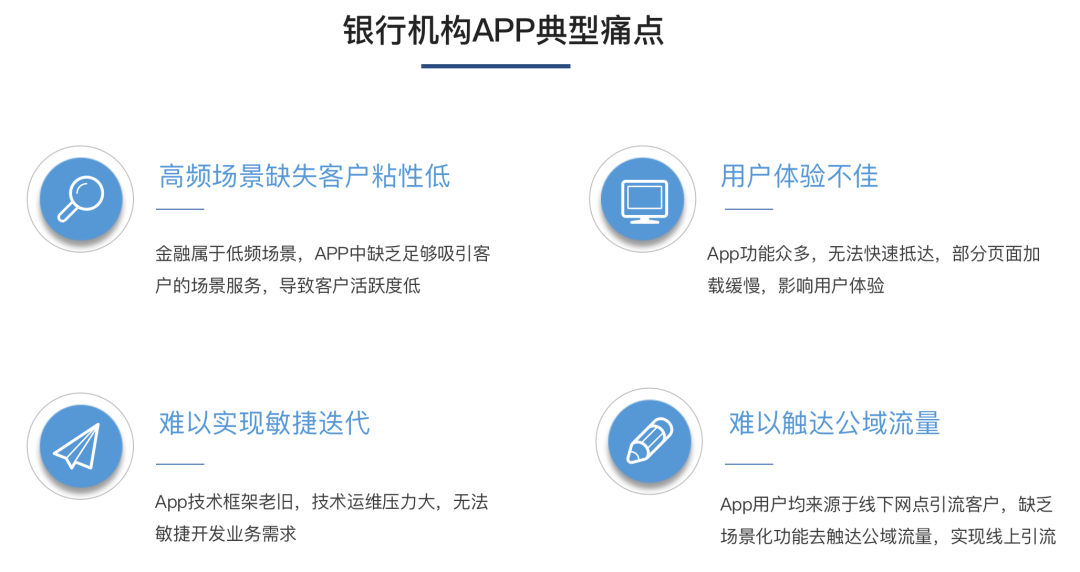
In the user operations system, there are four stages covering the App lifecycle: customer acquisition, increasing activity, improving retention, and self-propagation, ultimately forming a user funnel analysis model. For mobile banking Apps, the retail customer base is massive, and the financial side has relatively strong monetization capabilities. However, since financial scenarios are low-frequency scenarios, user stickiness and activity levels have always been relatively low. This is the pain point that mobile banking Apps urgently need to address in the mobile internet era.
But this is by no means an intractable problem. Improving App activity and retention rates requires providing a better user experience. As long as the user experience improves, user stickiness and activity will naturally increase.
For mobile banking Apps, the top priority for improving user experience is to perfect the scenario-based financial ecosystem. In the mobile internet era, banks' competitors are not only peers but also major internet companies. Internet companies use lifestyle scenarios as entry points, gradually penetrating into payment, credit, wealth management, and other financial service areas, building rich scenario-based financial ecosystems, changing user behavioral habits. Pure and independent financial services are increasingly difficult to reach customers directly, and banks face the risk of becoming product suppliers, with the direct connection between banks and customers being diminished.
Against this backdrop, banks urgently need to change their business thinking and methods—from making products to serving users, from making features to creating experiences—with enhancing user experience as the core goal.
Taking coverage of high-frequency lifestyle scenarios as an example, the core of mobile banking App operations is to build a scenario-based financial ecosystem. Scenario-based finance means embedding financial activities into various lifestyle scenarios, providing customers with a closed-loop ecosystem from lifestyle needs to financial solutions. The more complete the scenario ecosystem, the higher the user dependency. For mobile banking Apps, the lack of high-frequency lifestyle scenarios is currently the biggest pain point and a shortcoming that urgently needs to be addressed. In addition, innovating products and services in segmented areas for segmented groups, and broadening and extending the user service lifecycle, are also conducive to exploring the value growth space of retained users.
Mini-Program Architecture — The Key to Open Integration
The Mini-Program architecture will become an important force in building bank App ecosystems, serving as an important connector between Apps and colorful lifestyles, providing services to users in different scenarios. Banking institutions can open their own application programming interfaces and introduce various featured Mini-Program businesses into their Apps to meet users' non-financial needs. Moreover, through Mini-Programs, refined and localized operations of user services can be achieved to meet the unique needs of segmented user groups.
The benefits of doing so: First, external empowerment, strengthening one's own core business direction; Second, through continuous construction and layout focus, concentrating on deepening services in the user lifestyle services domain; Third, exporting comprehensive solutions to industry merchants, forming a multi-party win-win situation.
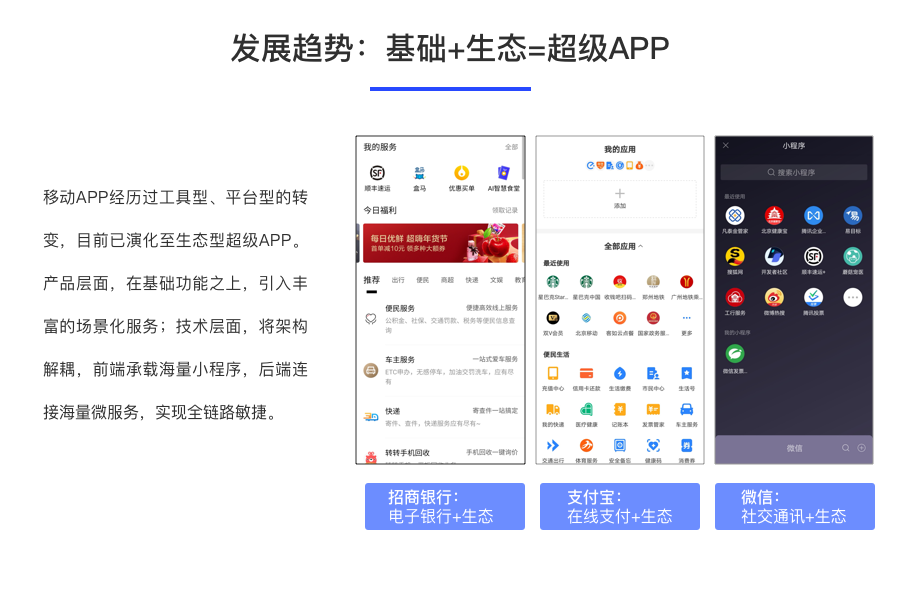
Secondly, as the complexity of banks' overall IT systems continues to increase, technical architectures are required to be more flexible and better at rapidly configuring business. The introduction of Mini-Program technology architecture can effectively help with application governance. Mini-Programs can be independently developed and tested, support Hot Update, and do not interfere with the Host-App, which can solve problems such as excessively high release frequency of bank Apps, quickly responding to business needs and enabling rapid iteration. In terms of experience, Mini-Programs achieve a good balance between performance and flexibility. By fully utilizing system UI, thread collaboration, and caching technologies, users can enjoy an interaction experience superior to H5 and nearly identical to native applications.
A Mini-Program ecosystem can not only help enterprises establish a hub for "fragments," reduce management costs, and improve R&D efficiency, but also form their own digital ecosystem and establish genuine digital connections with customers and partners.